|
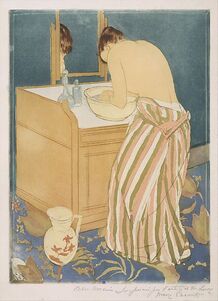
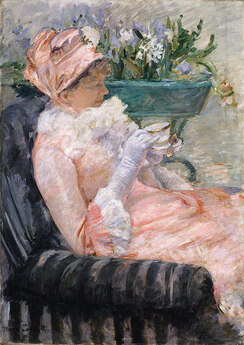
The Influence of Japonisme Japonisme began in the mid-19th century, when there was an increased interest in Japanese prints across the West. They began to be sold in many different kinds of stores as well as being exhibited in showcases, most famously the ukiyo-e prints in Paris. Japanese art had a large impact on the direction many artists decided to take with their work after viewing it, heavily influencing and inspiring a new approach. This can be evidently seen from the work American painter Mary Cassatt produced in the 1980's which draw great influence from Japanese artist Kitagawa Utamaro's work.
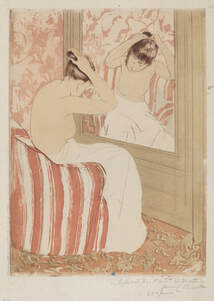
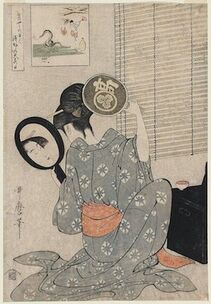
Cassatt drew inspiration from Japanese woodblock prints she viewed in the exhibition at the École des Beaux-Arts in Paris. Later going on to exhibit a series of her own coloured prints with The Coiffure being inspired partly by Takashime Ohisa Using Two Mirrors to Observe Her Coiffure, from her personal collection. All three of the prints shown above display a woman in front of a mirror going about her daily life. While Utamaro's work on the right features traditional Japanese items, Cassatt has adapted his style in order to present the daily life of women in France, where she spent most of her life. Despite this clear influence from Utamaro, by doing this she distinctly made the work her own by developing the Japanese style to suit her own compositions rather than simply copying the original exactly. This shows that she understood what made the ukiyo-e prints so distinct however going on to apply this style within a Western context. Simplifying the forms and colour of the piece inspired by the printing method allowed Cassatt to focus on the story she wanted to tell in the painting with the actions of the woman, making it the clear and distinct focal point.
Despite this, her compositions still have similarities. The close framing of her subjects creates a crowded atmosphere despite the limited number of objects in the scene. This choice gives a sense of closeness to the subject as though we are with them rather than just seeing them through a painting, allowing her work a sense of life. Japonisme allowed her to stretch the boundaries of her art, learning to experiment further with how she can produce her work and in what way to go about it.
0 Comments
Leave a Reply. |
Mia BickertonIllustrator Archives
December 2020
Categories |

 RSS Feed